
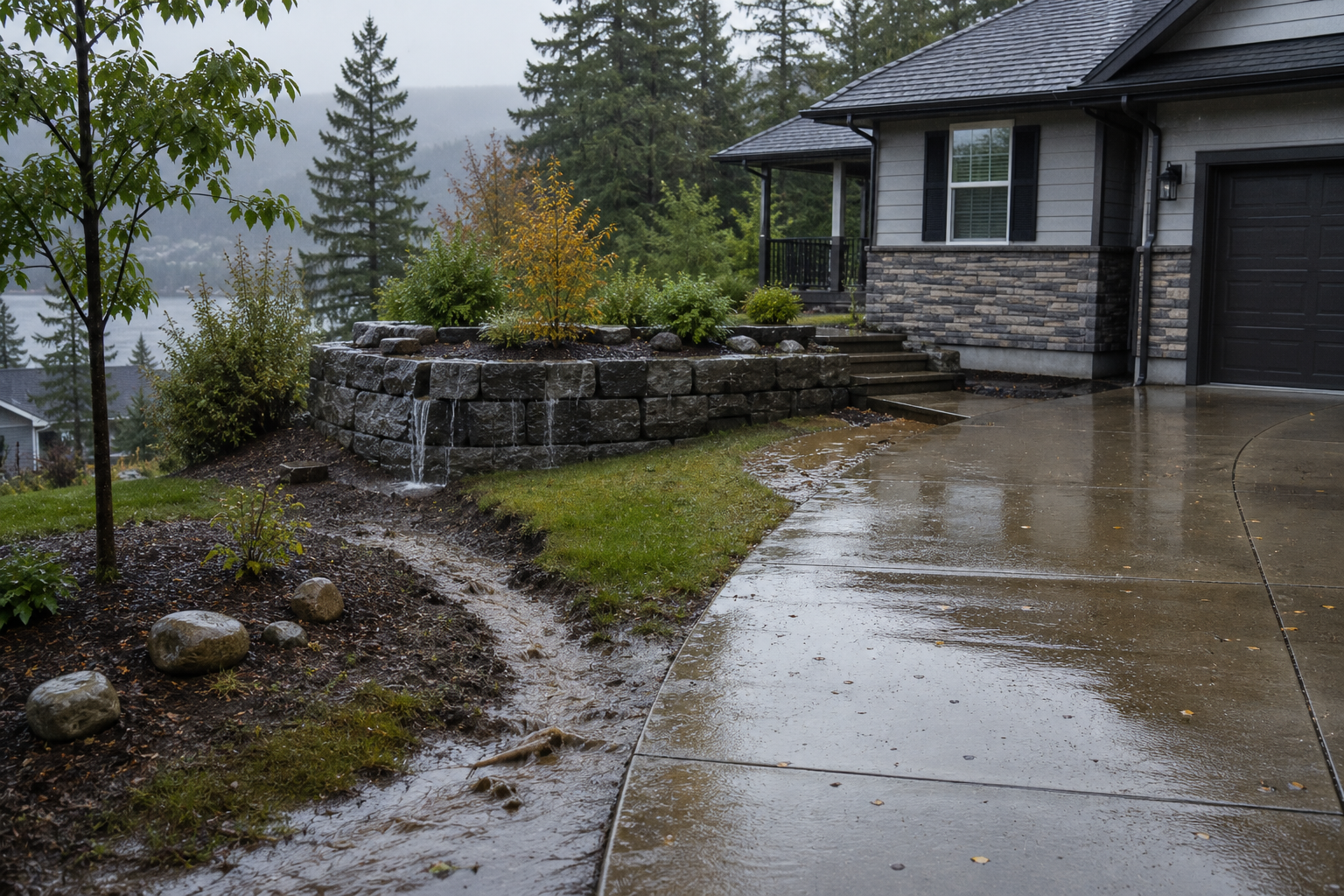
Summer has a way of hiding problems.
The ground is dry. The sun is shining. That puddle you noticed during spring snowmelt is long forgotten.
Then the first good fall rain arrives.
Suddenly, water starts moving—and it can reveal a lot about how well your property is actually working.
The next time we get a heavy rain in the Shuswap, don’t just watch it from the window. Once it’s safe to do so, take a walk around your property.
Here are some things worth looking for.
1. Is Water Pooling Near Your Foundation?
Start with the house itself.
Water should generally move away from your foundation, not collect beside it.
If you notice puddles forming against the house or areas of soil that remain saturated long after the rain stops, it may indicate a grading or drainage issue worth investigating.
Water problems are much easier to address before they become problems inside the home.
2. Which Way Is the Water Actually Going?
This sounds obvious, but many homeowners have never watched how rainwater travels across their property.
During a heavier rainfall, look at the natural flow.
Does water move toward the street or an appropriate drainage area?
Or does it run toward the house, garage, retaining wall, stairs, or other structures?
Changes in landscaping, soil settlement, driveways, patios, and other construction can influence how water moves over time.
Understanding where it goes is the first step toward managing it properly.
3. Check Your Downspouts
Your gutters may be doing their job perfectly—but where is all that water going once it reaches the ground?
If a downspout releases large amounts of water immediately beside the foundation, onto an area with poor drainage, or somewhere that causes erosion, the problem has simply moved from the roof to the ground.
After a good rainfall, check where each downspout is directing water and what happens from there.
4. Look at Your Retaining Walls
Retaining walls don’t just hold back soil. They also need to deal with water.
After heavy rain, look for signs such as:
- Water accumulating behind or around the wall
- Soil washing through or around sections
- New erosion
- Bulging or leaning
- Movement in blocks or materials
- Areas that remain unusually saturated
A retaining wall showing movement deserves attention, particularly if the problem appears to be getting worse.
5. Look for New Erosion Channels
Water will find a path.
And sometimes it creates one.
Small channels forming through soil, landscaping, gravel, or beside pathways are signs that runoff is concentrating in that area.
It may look minor after one storm, but repeated rainfall can gradually remove soil and make the problem larger.
If you’re suddenly seeing little streams running through places where they shouldn’t be, take note.
6. Check Around Your Deck and Fence Posts
Take a look at where outdoor structures meet the ground.
Is water consistently pooling around deck supports or fence posts?
Are certain areas remaining wet?
Is soil washing away from footings?
Repeated exposure to excess moisture can contribute to deterioration and instability over time, particularly with wood structures.
Good water management helps protect more than just the house.
7. Don’t Forget the Driveway
Your driveway can tell you quite a bit about drainage too.
Watch for:
- Large puddles
- Water flowing toward the garage
- Gravel washing away
- New channels or low spots
- Water repeatedly crossing walkways
These can indicate grading or drainage patterns that may need attention.
8. What Happens After the Rain Stops?
This part is important.
Some temporary surface water during very heavy rain isn’t necessarily unusual.
What matters is what happens afterward.
Walk around again later.
Are certain areas still saturated?
Has the water disappeared?
Is one part of the lawn consistently wetter than everything around it?
Persistent problem areas can provide valuable clues about what is happening beneath the surface.
Your Property Is Giving You Information
Rain isn’t just weather.
From a property-maintenance perspective, it’s information.
It shows you:
where water enters, where it travels, where it collects, and where it leaves.
And those four things can tell you a surprising amount about your grading, drainage, landscaping, retaining walls, driveways, and outdoor structures.
Don’t Wait Until a Small Problem Becomes a Big One
Drainage isn’t necessarily the most exciting home improvement project.
Nobody invites their friends over to admire where the water goes.
But good drainage quietly protects many of the things homeowners spend money building.
Your foundation.
Your landscaping.
Your retaining walls.
Your deck.
Your driveway.
And your yard.
At Rooke Construction, we help homeowners throughout the Shuswap with grading, drainage, retaining walls, and other property improvements designed to work with the site—not against it.
So when the first heavy fall rain arrives, take a look outside.
Your property might be trying to tell you something.