
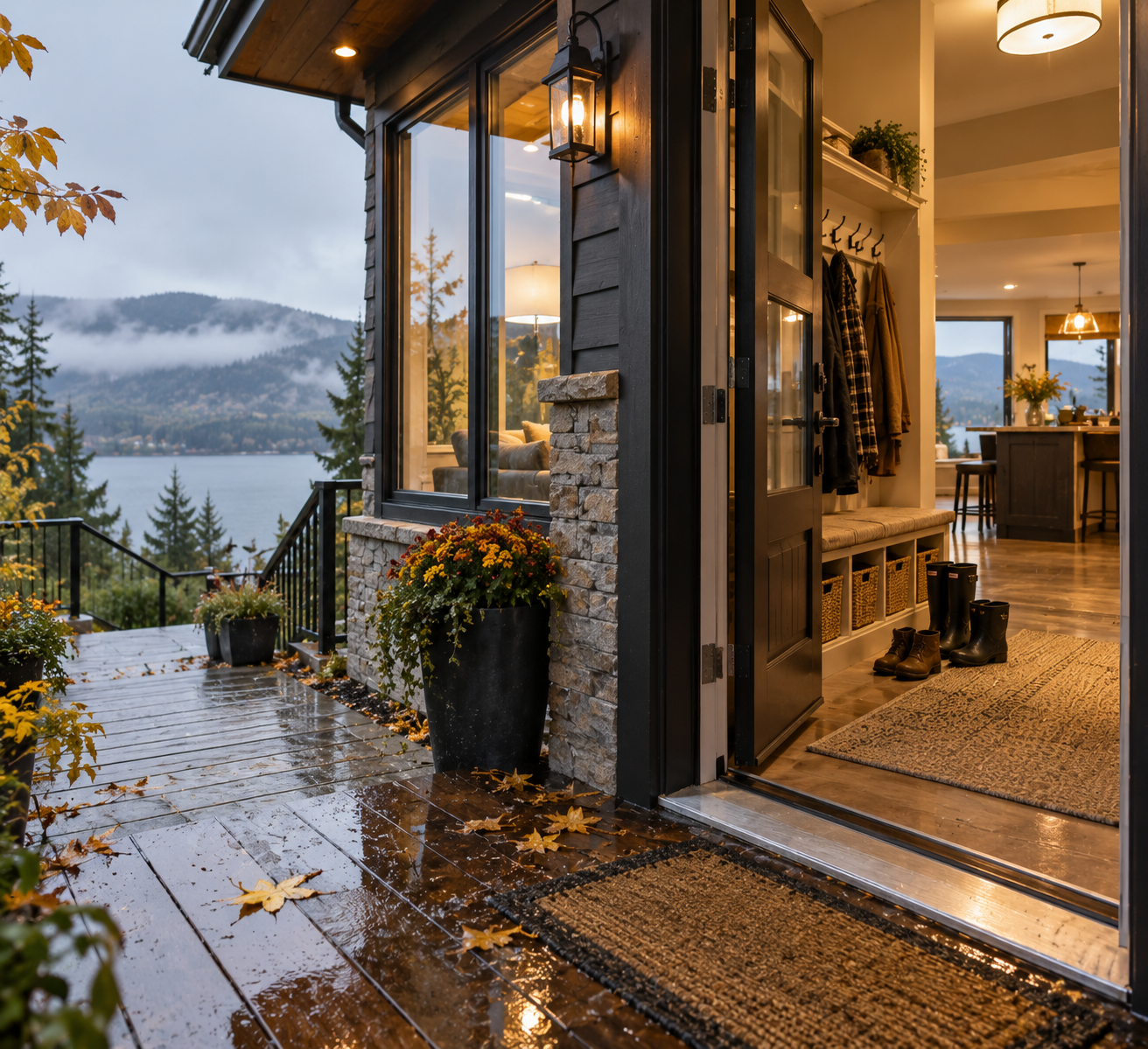
Summer is pretty easy on a house.
Doors are open. Shoes stay relatively clean. We spend more time outside. The BBQ gets more attention than the kitchen, and the backyard practically becomes another room.
Then fall arrives in the Shuswap.
The rain returns.
Temperatures start dropping.
Wet shoes appear at the door.
We spend more time indoors.
And suddenly, our homes have a much bigger job to do.
Fall has a way of revealing little problems we barely noticed during summer. So before winter arrives, this is a great time to look at your home differently—not simply asking “What needs fixing?”, but:
“What could work better?”
Start Outside: Where Is the Water Going?
After months of relatively dry weather, fall rain puts your property back to work.
Pay attention to how water moves around your home.
Are there areas where water consistently pools?
Is runoff travelling toward the house?
Are certain areas of the yard becoming saturated?
Does water collect around outdoor structures?
You don’t need to diagnose the problem yourself. Simply noticing changes can help identify something worth investigating before another winter and spring snowmelt arrive.
Sometimes the first sign that something needs attention isn’t damage.
It’s water showing up somewhere it shouldn’t.
Take Another Look at Your Steps and Railings
In July, walking up the front steps in sandals on a sunny afternoon is one thing.
Doing it in November when it’s dark, wet, or icy is another.
Fall is a good time to pay attention to the areas you use to enter and leave your home.
Do stairs feel secure?
Are railings solid?
Is access comfortable?
Are there areas that become slippery or difficult to navigate when conditions change?
The features we barely think about in summer can become considerably more important as the weather changes.
Then You Walk Through the Door…
And fall comes with you. 😂
Shoes.
Boots.
Coats.
Umbrellas.
Backpacks.
Sports gear.
Eventually gloves, hats, and everything else winter brings.
Suddenly that entrance that worked perfectly well all summer feels approximately three sizes too small.
This is where good interior design becomes less about decoration and more about function.
An entrance or mudroom can benefit from surprisingly simple improvements:
Built-in storage.
A bench.
Better organization.
Durable flooring.
Hooks where people actually need them.
Better lighting.
A designated place for shoes and wet clothing.
Sometimes improving one relatively small area can make the entire house feel more organized.
Now That You’re Inside More… How Does the House Actually Feel?
Summer can distract us from interior spaces.
We’re outside.
Windows are open.
Days are long.
Then fall arrives, evenings get darker, and we start noticing things again.
That room is darker than we remembered.
The kitchen gets crowded when everyone is home.
There’s nowhere to put things.
The bathroom still needs updating.
The basement is technically a room—but nobody wants to spend time there.
Fall can be a great time to look at the way your home functions when you’re actually living inside it more often.
And sometimes the answer isn’t adding more space.
It’s making better use of the space you already have.
Light Becomes More Important
Shorter days change how a room feels.
A space that seemed perfectly bright in June may feel completely different during a dark November afternoon.
Lighting can influence comfort, functionality, and even how large a space feels.
Sometimes improvements are relatively straightforward.
Other times, lighting is part of a larger renovation involving layout, finishes, cabinetry, or how rooms connect.
The goal isn’t simply to make a room brighter.
It’s to make it more comfortable to use throughout the year.
The Rooms That Work Harder Deserve Attention
Certain areas of the home naturally take more abuse once the weather changes.
Entrances.
Mudrooms.
Kitchens.
Bathrooms.
Laundry rooms.
Basements.
These aren’t always the glamorous rooms that dominate inspiration boards.
But they’re often the spaces that determine whether everyday life feels organized—or chaotic.
A successful renovation doesn’t necessarily begin with:
“What would look amazing?”
Sometimes the better question is:
“What part of our daily routine is frustrating us?”
That’s often where the most valuable improvements begin.
Don’t Forget What’s Outside Just Because Summer Is Ending
Fall doesn’t mean outdoor spaces stop mattering.
Decks, fences, retaining walls, driveways, stairs, railings, and other exterior areas will continue dealing with changing weather long after the patio furniture is put away.
This is a useful time to simply observe.
Does anything look different from last year?
Has something moved?
Is water behaving differently?
Is there deterioration you intended to address this summer but never quite got around to?
Not every observation means there’s a major problem.
But knowing what’s happening around your property gives you the opportunity to plan rather than react.
Fall Is a Transition—for Your Home Too
Preparing your home for fall doesn’t have to mean creating an enormous checklist.
Sometimes it’s simply about paying attention to how your house changes with the season.
Walk from the yard to the front door.
Come inside.
Look at where everyone puts their things.
Notice which rooms you naturally use.
Notice which ones you avoid.
Think about what frustrated you last winter.
And ask yourself:
“What could make living here easier this year?”
At Rooke Construction, we work with homeowners throughout the Shuswap on both exterior construction and interior renovations, helping create spaces that aren’t just designed to look good—but to work well through every season.
Because your home is about to work a little harder.
It might be worth making sure it’s ready.